


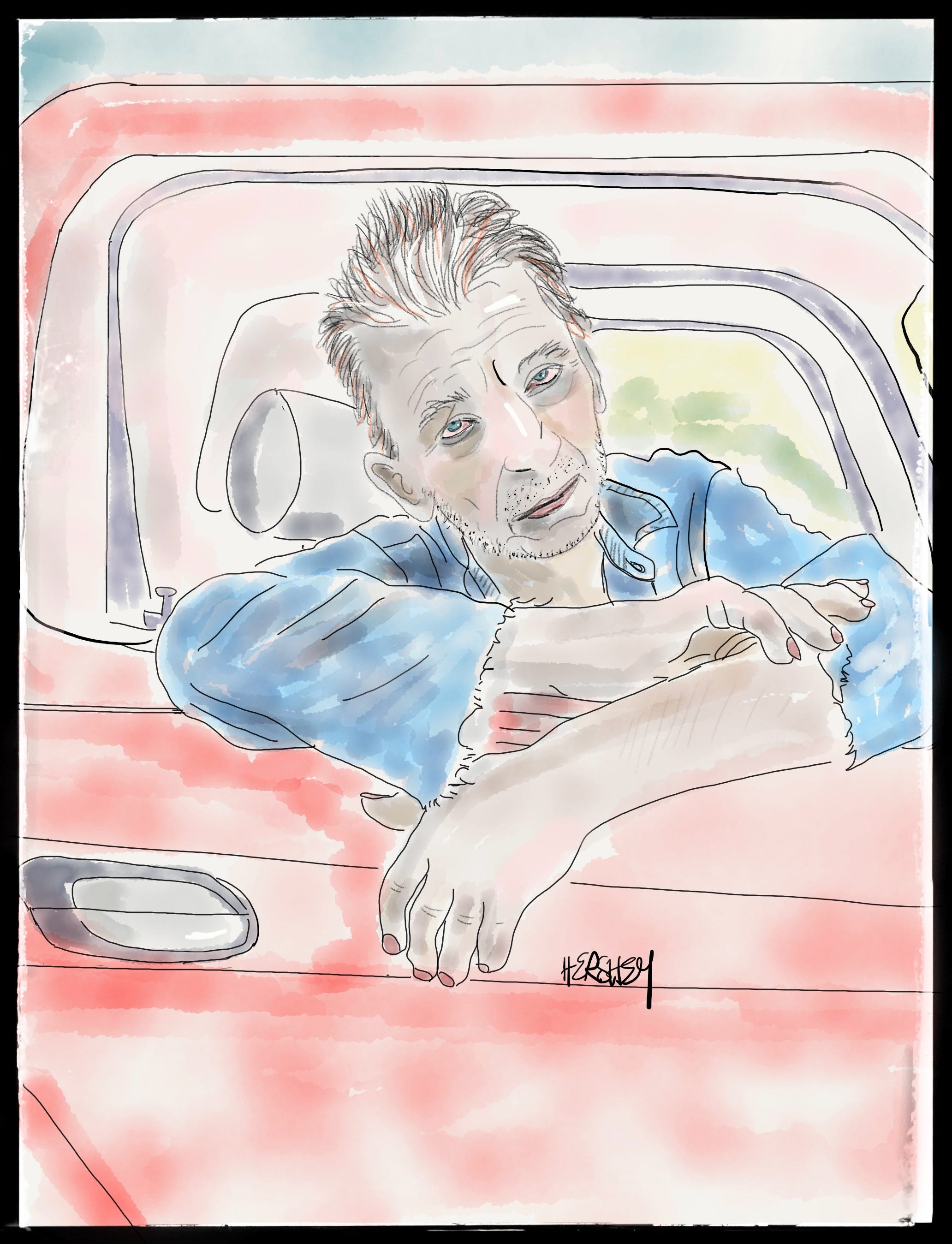
On the first day of our Lake Huron adventure, we encountered an unexpected predicament. I cluelessly locked Jenny’s bike to a wooden gazebo using a combination lock, and it unexpectedly seized up. After trying to undo the slipped tumbler, we resorted to a new strategy: disassembling the gazebo just enough to liberate the bike. Once free, the Kevlar lock still remained looped around the front rack of Jenny’s bike, forcing a clever arrangement of zip ties to clear the front wheel. Our minds raced, wondering who on the Bruce Peninsula might be able to cut through a heavy-duty lock. We figured a local boatyard might have the machinery required, so we loaded the bike on our rack, and set off. Our search led us to a local hardware store. Walking inside, Jenny greeted a group of men and loudly asked, “You wanna hear a funny story?”
A local crowd rallied to the challenge. With each increasingly massive set of bolt cutters the store owners hauled out, the tension grew, until the lock finally snapped to enthusiastic cheers from everyone in the shop. It was an incredible amount of excitement for a hardware store. Among our crowd of supporters was a local character named Paddy, who had arrived earlier, full of advice, in a tiny, one-man electric vehicle. But the moment I biked away, Paddy turned to Jenny and offered an invitation of his own: to join him back at his cottage for a stiff whiskey and a skinny dip. Friendly folks, indeed!
The Place
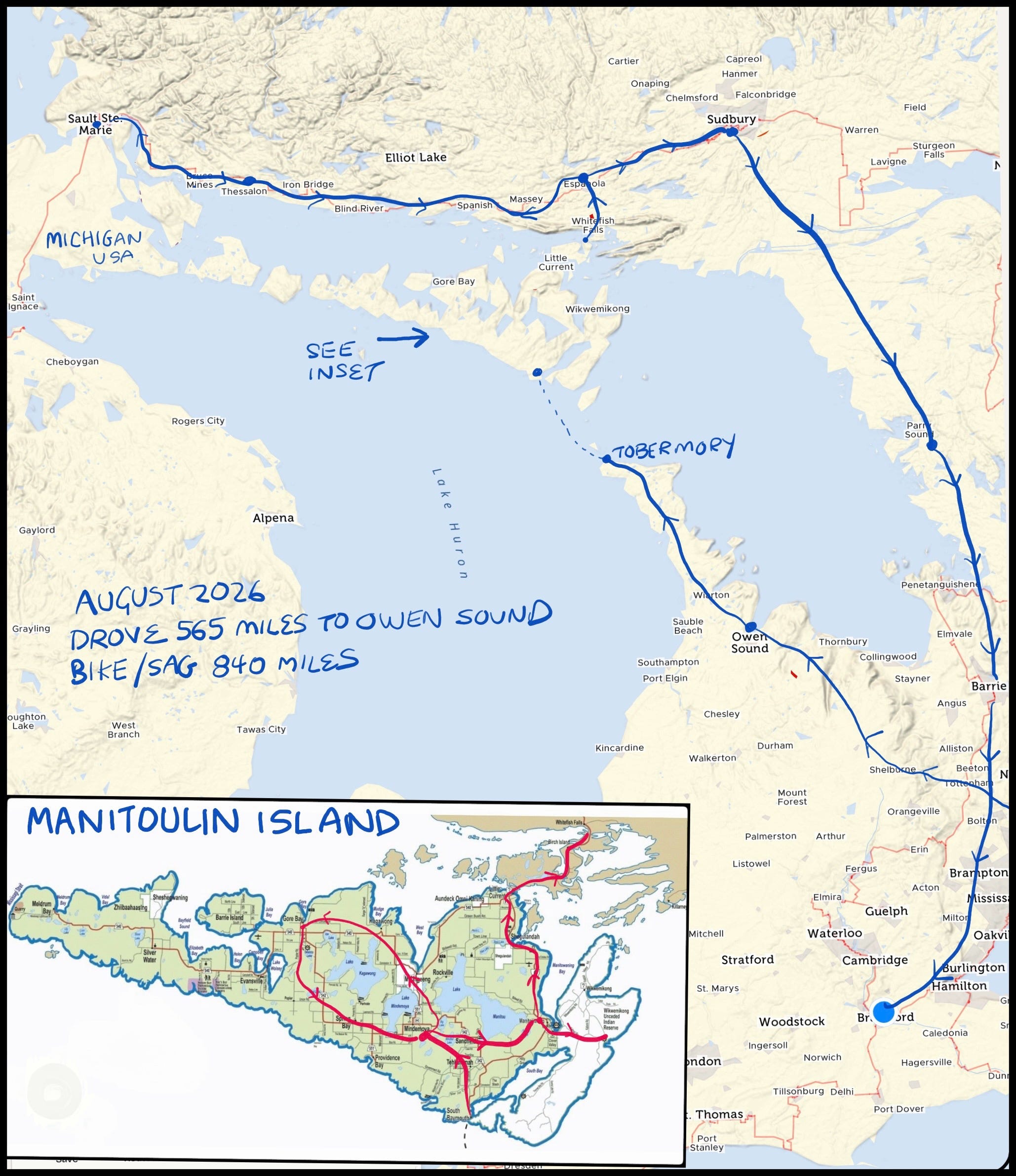
We left New York by car with our electric gravel bikes on our reliable Quikr bike rack on a lovely day. The weather held, making the long drive past the Toronto area up the Bruce Peninsula toward the little town of Tobermory go quickly. Jenny had time to bike 14 miles back to meet me as I rode up toward Tobermory from Owen Sound, where I had started my ride. Ever since Jenny’s cycling accident last fall in West Virginia, she splits her time as a SAG (support and gear) driver and cyclist, while I still cycle between destinations.
I've said it many times: Biking on the open road is an intimate way to experience nature. More importantly, it is a great way to take in the smells and sounds, wind and light, human infrastructure, industry and agriculture, plant life, animals, birds, topography, geography, weather, and climate of a particular location. We allow little details to sink in. Gradually, a “place” becomes something we can feel, both in the moment and later in our memories.
After Jenny reached me on the main road into Tobermory, we turned off the highway onto a bumpy side road that led down to the shore of Lake Huron. We meandered along for a few miles before returning to the highway. This was our first chance to look deeply at the landscape together. Typically, in this place, we'd be greeted by pale rock and a shoreline interspersed with turquoise colored water. But this was not a typical day. The rocky country here can be sepia, even white, on a good day, but it looked dull and flat, almost the color of asphalt. The dolostone that defines this peninsula was laid down a hundred million years ago, coral reef hardened first into limestone, then into dolostone, leaving a kind of stone pavement with little soil to support trees. From a car window, the rocks look barren. At cycling speed, they turn out to be crowded with dwarf lake iris, orchids, and grass of Parnassus, growing out of what resembles a parking lot.
The numerous wildfires burning north of us, carried by strong winds out of the northwest, were fouling the air in many American and Canadian cities. They were also impacting the Lake Huron area, making the sky dull, flat, and shadowless. The sky was blue on the morning we left Owen Sound but gradually became a pewter orange, reducing the sun to a muted, burnt sienna-colored ball I could look at directly without squinting.
Our 90-minute ferry ride the next day from Tobermory to Manitoulin Island felt like a trip into the underworld. Wind forces are mercurial. The smoke was tolerably bad where we were, and it was clear Canadians are more used to wildfires than Americans. Still, we were surprised by how much the media in the States was focused on American suffering. It’s a common frustration among Canadians that their increasing number of devastating wildfires is driven far more by climate change caused by decades of greenhouse gas emissions coming from the United States than by their own actions.
Most of the wildfires in Canada originate in the boreal forest far to the north, on vast tracts of land that cannot be managed because they are very difficult to access. Canada is the second largest country on earth, yet it holds only 11 people per square mile. By contrast, the United States holds about 96 people per square mile. The majority of Canada's population lives close to the US border. Fuel reduction through thinning depends on people being nearby, and in most of Canada, they are not. Fires near towns and infrastructure get fought, but fires deep in the boreal forest burn until weather or terrain stops them.
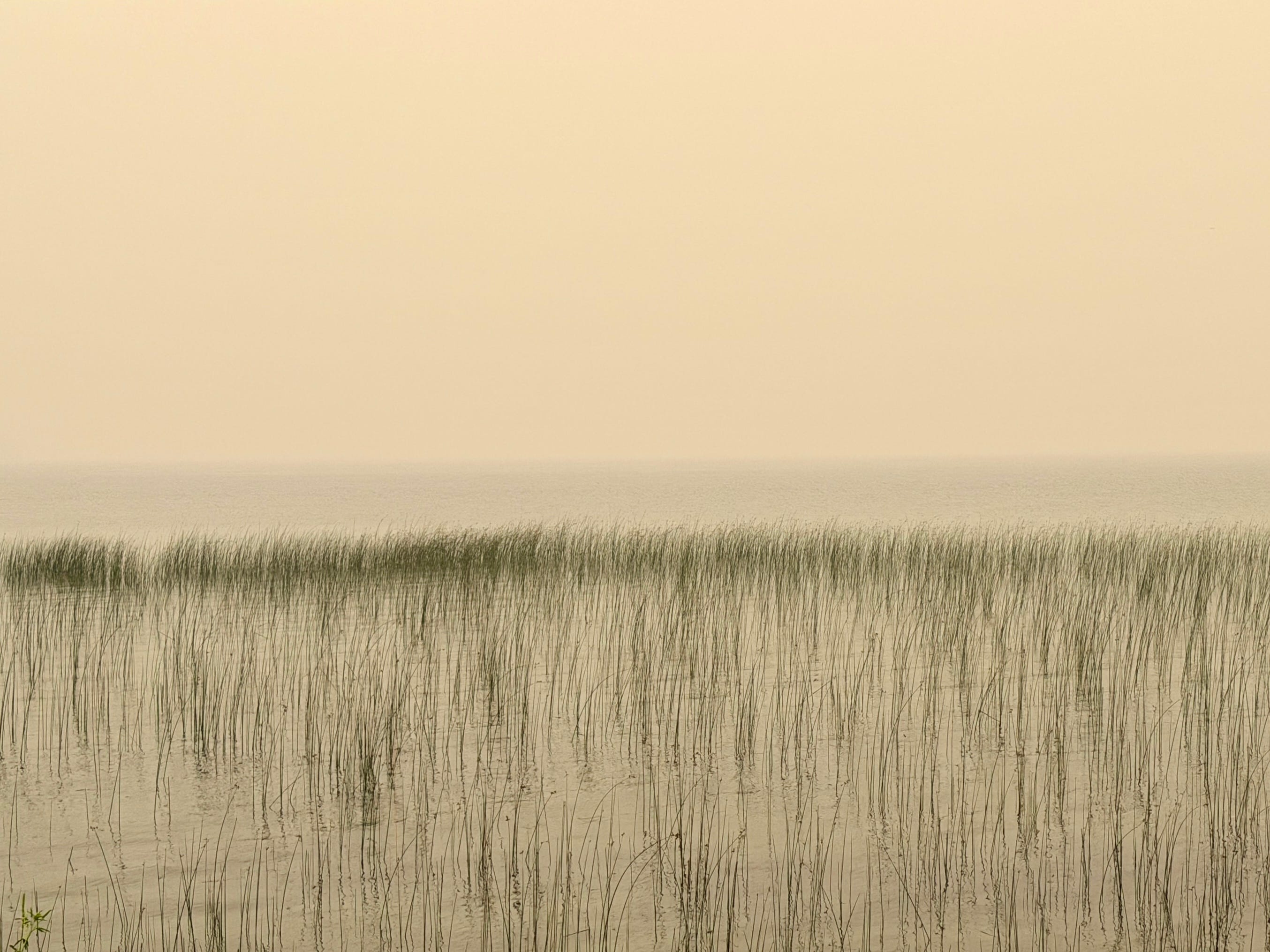
Bulrushes in the smoky haze on the shore of Lake Mindemoya.
Manitoulin Island is the largest freshwater island in the world, and the ferry to get there from the peninsula follows an ancient canoe route. The ship itself is named after the route: the Chi-Cheemaun. When we boarded, the air was a hazy brown and the land we passed on the way out of the harbor was practically indistinguishable from the sky. Manitoulin finally showed up through the haze, and we could barely make out farmland, split-rail fences and hayfields laid over more of the same pale dolostone we found on the Bruce Peninsula. The air was still hazardous, so we stayed in the car until we reached our simple, mid-century motel in Mindemoya. Evening winds helped clear the air a bit, so we hopped on our bikes for a short ride, feeling relief as we noticed the smell shift from burning wood to cut hay and warm asphalt.
The Anishinaabe still call this island Mnidoo Mnising, or the Island of the Great Spirit. In 1836, the Canadian government negotiated a treaty with the Anishinaabe: the island would be set aside forever for displaced Indigenous people across Upper Canada. Twenty-six years later, the government returned and claimed the land had not been settled enough to honor its promise. They carved the island into individual allotments and opened the land to white settlement, fostering a sad, quiet violence behind Manitoulin's cottage country, a summer-only northern counterpart to coastal resort life.
Mindemoya was still smoky the next morning, and the nearby lakes once again looked flat and gray. But the AQI showed signs of clearing up, so we set out on our bikes, hoping for a better day. The air stayed smoky until we reached Gore Bay, where the sky opened to a deep blue and the reeds along the boardwalk turned a saturated green. We stopped pedaling to enjoy a leisurely lunch in the clean air, glimpsing how this coastline is supposed to look.
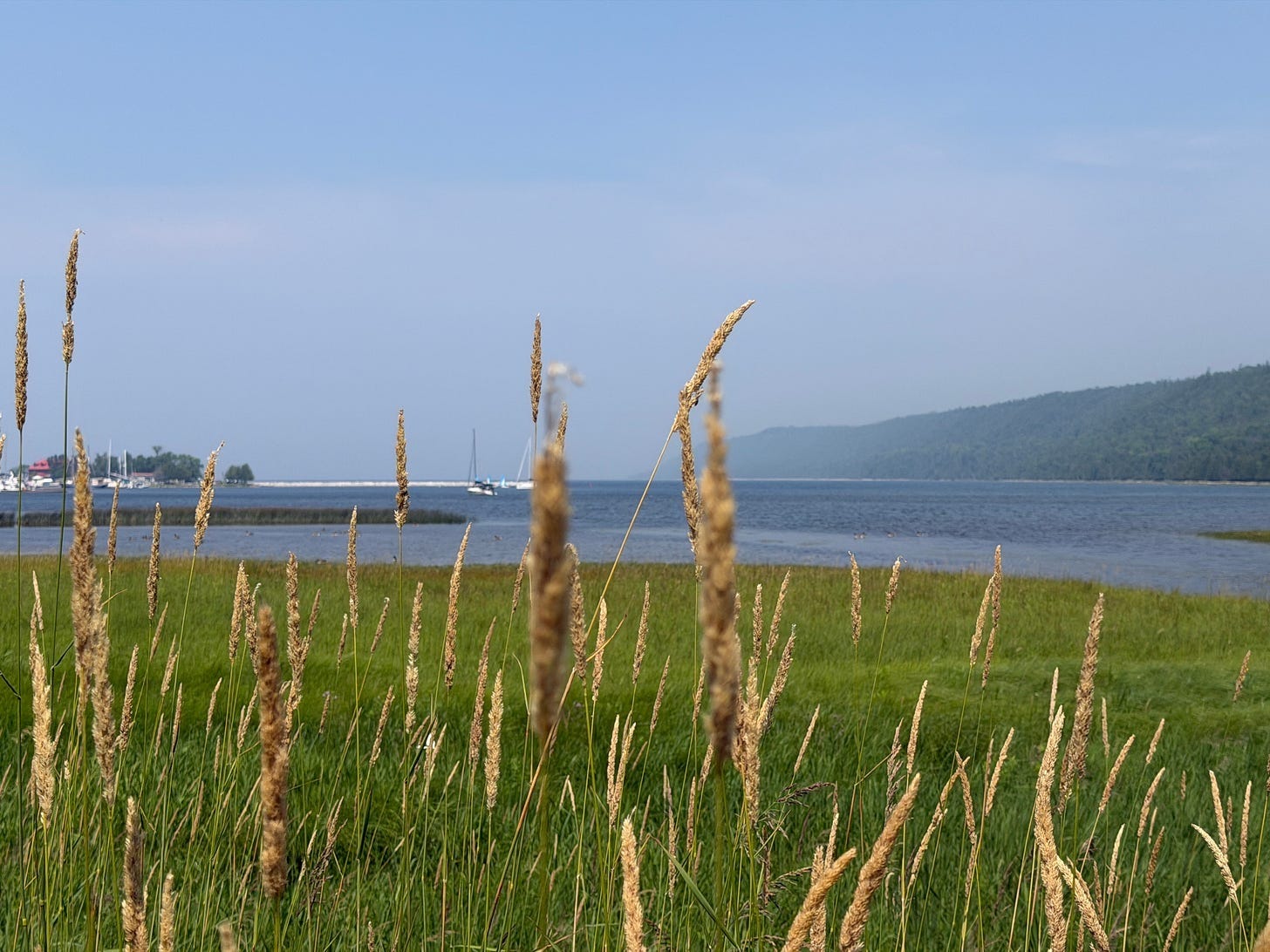
Cleaner air seen through beachgrass at Gore Bay on Manitoulin Island, Ontario.
Our enjoyment was short-lived. As we biked south back toward the motel in Mindemoya, we rode straight into a wall of smoke thick enough to taste. We stopped reflecting on the scenery and seriously worried we might be harming ourselves. The experience made me think a lot about what cycling will be like in the near future. A plume of smoke is defined by its edges, so the air in a town ten miles away might be hazardous while the sky ahead is clear, depending on which side of the plume you happen to be riding, especially in a crosswind. Although cars are hermetically sealed enough to avoid those consequences, cyclists are not. There is also the issue of how far upwind or downwind you are from the fire itself, and how the wind stacks the smoke. It might be thin and high one day and low the next. For all those reasons, the same stretch of road can swing from a moderate AQI reading to hazardous over just a few hours, without the wildfires upwind changing size at all.
We woke to cleaner air the next morning, the wind having shifted the plume off to the west overnight. We took advantage of the window and I headed northeast toward Manitowaning on my bike, while Jenny drove. Occasionally, a gap in the trees revealed the waters of South Bay, the air thick with the smell of cut grass and warm gravel dust kicked up by a rare passing truck. Manitowaning itself sits quiet on its harbor, defined by a park and marina built for a larger town. Jenny joined me there on her bike and we headed toward the village of Wikwemikong, where bush country closed back in on the land, and the scent shifted to pine and lake damp.
Wikwemikong is on a tract of land on Manitoulin that was never ceded to the Crown. While some western Canadian territories were simply never negotiated, this tract remains unceded by refusal. When the government returned to Manitoulin in 1862 asking the island's communities to sign away the rest of Manitoulin into individual settler lots, the people of Wikwemikong refused. Because of that, the territory exists today as its own legal entity rather than surrendered land parceled out a century and a half ago. Knowing that made cycling into Wikwemikong feel like crossing into a different country, even though nothing marks the boundary but a road sign and a change in the trees. Heading back, the landscape through Manitowaning revealed sights we missed the first time, including the only road to the northern shore of Lake Huron which turns toward Little Current and its famous (and about to disappear) swing bridge, a town we would pass through the next day on our ride to Espanola.
The air continued to clear.
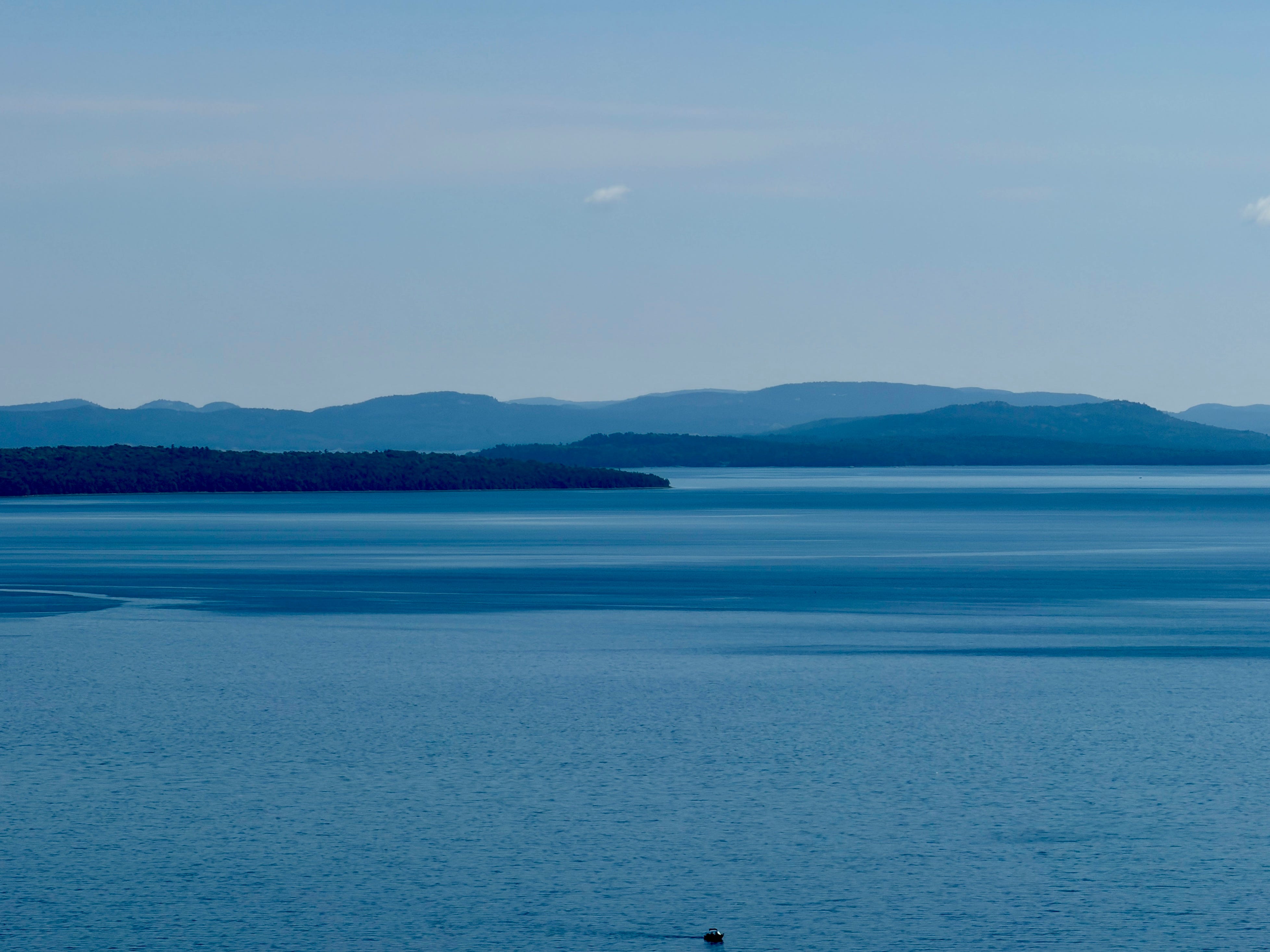
Our view the next day. Before the road to the North Shore gets to Little Current, it passes the iconic Ten Mile Point on Manitoulin.
North of the swing bridge, flat farm country ends. The Canadian Shield asserts itself as outcrops breaking through the treeline. Soon after, the horizon opens up to countless lake-studded islands along the rocky shore. Further away from the water, on the upper slopes of the Shield, the forests look thick and intense. Further up, Espanola sits on the Spanish River, a mix of rock, forests and lakes, shopping malls, modest homes and beat-up roads. Built in 1899 for the Spanish River Pulp and Paper operation, Espanola is a company town down to its bones. Its history has been a caricature of boom and bust: thriving through the 1920s, a ghost town when the mill closed during the Depression, repurposed as a prisoner-of-war camp during the Second World War. It was then bought and reopened in 1943 by Americans, and later sold to the international company, Domtar, who idled the mill for good in the fall of 2023, laying off about 450 workers. A property company bought the site in 2025 and is studying new uses, including a biocarbon plant. For now the mill sits quiet on the river, its stacks cold.
As to the AQI, it was in healthy territory again. It only hit moderate levels one day, on a ride we took through heavy forest and countless lakes on our way to the Mountain Cove Lodge on Lake Panache, one of several tourist outfits that are common in these parts. Until the late 1940s, a person could make a living around this shoreline hauling lake trout by the net-load. Twenty million pounds of fish were landed across Huron, Michigan, and Superior in a good year. Boats returned heavy. Fish houses lined the docks, smelling of scales, diesel, cold water. But within twenty years, the sea lamprey rode in through shipping canals and drove the fish population down considerably (as much as 98% by some accounts). Ontario closed the trout season outright in 1962. Working docks are mostly gone from this shore now, tourism filling the void where fishing used to be.
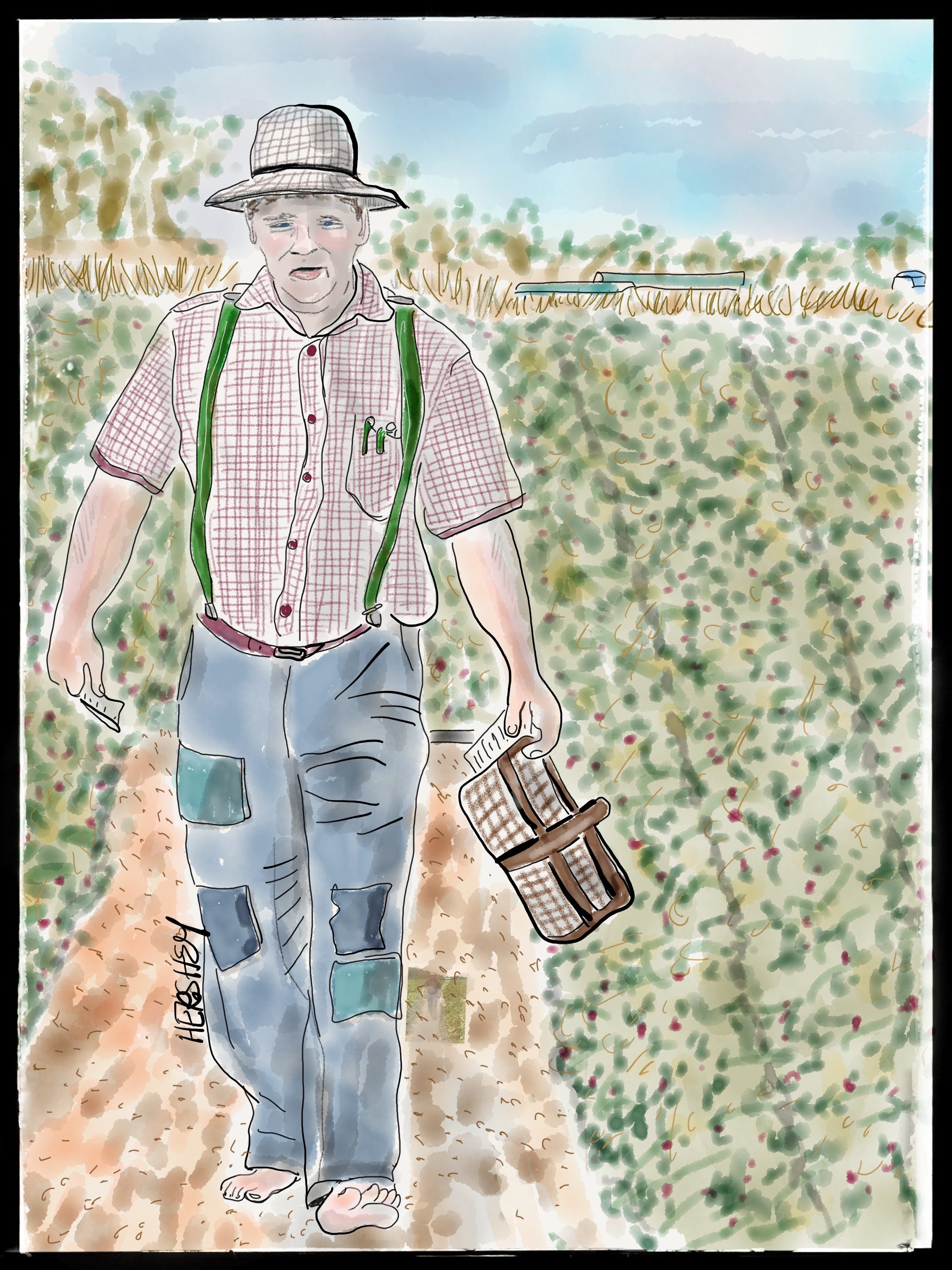
We met Joel, a Mennonite farmer, while he was tending crops barefoot outside Espanola. His daughters run a roadside stand filled with magnificent cucumbers, zucchinis, and various lettuces. Joel walked Jenny through a strawberry field infested with Drosophila (aka strawberry worms), which had devastated much of his crop. Joel remained optimistic anyway, grateful for the strawberries that survived. In the early 2000s about twenty Mennonite families moved north into this stretch of Ontario. They were being priced out of Waterloo and Elmira as Toronto's sprawl made farmland more expensive. Settling along river valleys and old logging roads west and north of Espanola, the families found decent farmland cheap enough to work. To this day some of the stricter families use no electricity, although they run sawmills and farm stands between the fields. Others use tractors and trucks instead of horses.
For several hundred miles to the west along the shoreline and up into the interior, the rock is pink and gray granite, the older and harder white quartzite spine of the La Cloche range. I found this landscape more interesting than the isolated flatness of Manitoulin. From a bicycle, rock defines the shorelines of lakes more than trees. Many of the smaller towns along the coast feel wedged into the rock rather than laid over it. For miles and miles, black spruce and jack pine stand in straight rows along the highway shoulder, the way trees do in second-growth forest, inevitably interrupted by stunning (and less organized) marshes and fertile farmland. The white quartzite underfoot runs northwest in a broken chain past occasional farms and seemingly endless forests and lakes and extends inland to Sudbury. A large meteorite crashed into the earth there, 1.85 billion years ago, leaving behind a massive basin and the nickel and copper that built the city, broke it, and is now rebuilding it.
Sudbury's history reflects boom-and-bust patterns to an extreme. Continuous mining of the local ore (mainly copper and nickel) began here in 1886, leading to a workforce peak around 1972. But sadly, Canada's share of the world nickel supply fell from ninety-five percent to about a third of that within a generation. The original mining company, the International Nickel Company of Canada, known as INCO, operated the district for most of the twentieth century before a Brazilian company, Vale, absorbed it in 2006.
For over a hundred years, smelter emissions blackened rock and killed soil across the basin. Thousands of lakes acidified. By the early 1970s, Sudbury was so barren that NASA sent astronauts there to train on ground that looked like the moon. At its worst, about 77 square miles held no vegetation at all. Including the birch transition zone around it, the damage stretched closer to 310 square miles. Acid rain reached further still, killing most of the fish in over 7,000 lakes across 6,560 square miles. Copper Cliff (INCO's company town before it was incorporated into Sudbury) sat a few hundred meters from its own smelter stacks. The nearby town of Coniston, a few miles to the east, was built around a nickel smelter. Families raised their children in toxic air their fathers helped create that had already shortened lives. This was not the moon; it was where people lived.
In 1978, miners in Sudbury started a strike that would become the longest in Canadian labor history, lasting over nine months. As it dragged on, it became economically devastating to a community that was already exhausted. Ironically, at about the same time, researchers at Laurentian University hypothesized that crushed limestone spread over bare rock, followed by a seed mix of grass and legume, might neutralize the soil enough for pine seedlings to take root on the barren Sudbury landscape. It was labor-intensive and slow work, and took a few years to pan out, but it worked. Gradually the city began to rediscover hope. Laid-off miners needed work, and the city needed hands to cover the barrens with lime and plant seedlings. INCO itself eventually partnered with ex-miners on its own land, funding the distribution of lime and seed planting alongside municipal crews and volunteers, a role Vale continued after acquiring the company in 2006. Suddenly, both despair and hope shared a payroll. Nobody had planned this as a turning point, but the shift has resulted in one of the more promising stories of economic and environmental reclamation of our age.
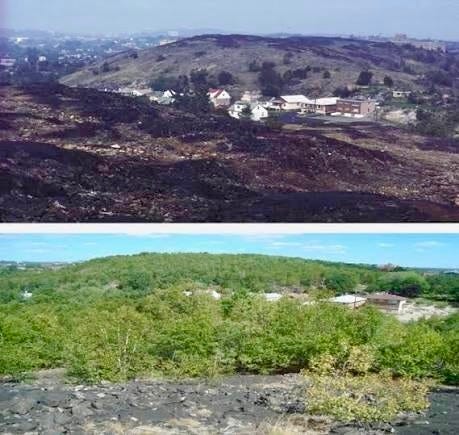
Before and after photos demonstrating the dramatic landscape transformation of Sudbury, Ontario, through its successful municipal regreening program. Google image courtesy of Laurentian University.
At cycling speed second-growth pine and birch shade long stretches of roadway through the basin. It looked ordinary to us at first. Then we learned the fascinating story of what it looked like fifty years before. More than ten million trees have been planted. Moose, bear, nesting owls and most conspicuously, loons, have returned to ground that once held nothing but blackened outcrop. Sudbury is now a proud model for industrial land recovery. It can definitely be felt and seen as a "place," both in the moment and in the city's memory.
The meteorite basin that both built and nearly broke this city is now positioning it for yet another revival. Nickel, copper, and cobalt are essential metals in batteries. Sudbury sits on one of the largest nickel and copper deposits in the world. Every Canadian we spoke to about the minerals tells us there is a massive abundance of remaining ore to be mined. By converting local ore into nickel sulphate, Sudbury is now a key supplier of ingredients for electric vehicle batteries. This was brought home to me and Jenny as we took a Science North "Next-Generation" Mine Tour, a look at modern mining technology and automation. Vale, which owns the mine used for the tour, intends to completely electrify its operations as part of the push to decarbonize. That means electrifying every possible operation, including vehicle use in mines, air flow, lighting, and ventilation. As part of that effort, we were able to view several battery-electric underground load-haul-dump loaders that run on 100% battery-electric propulsion with zero exhaust emissions.
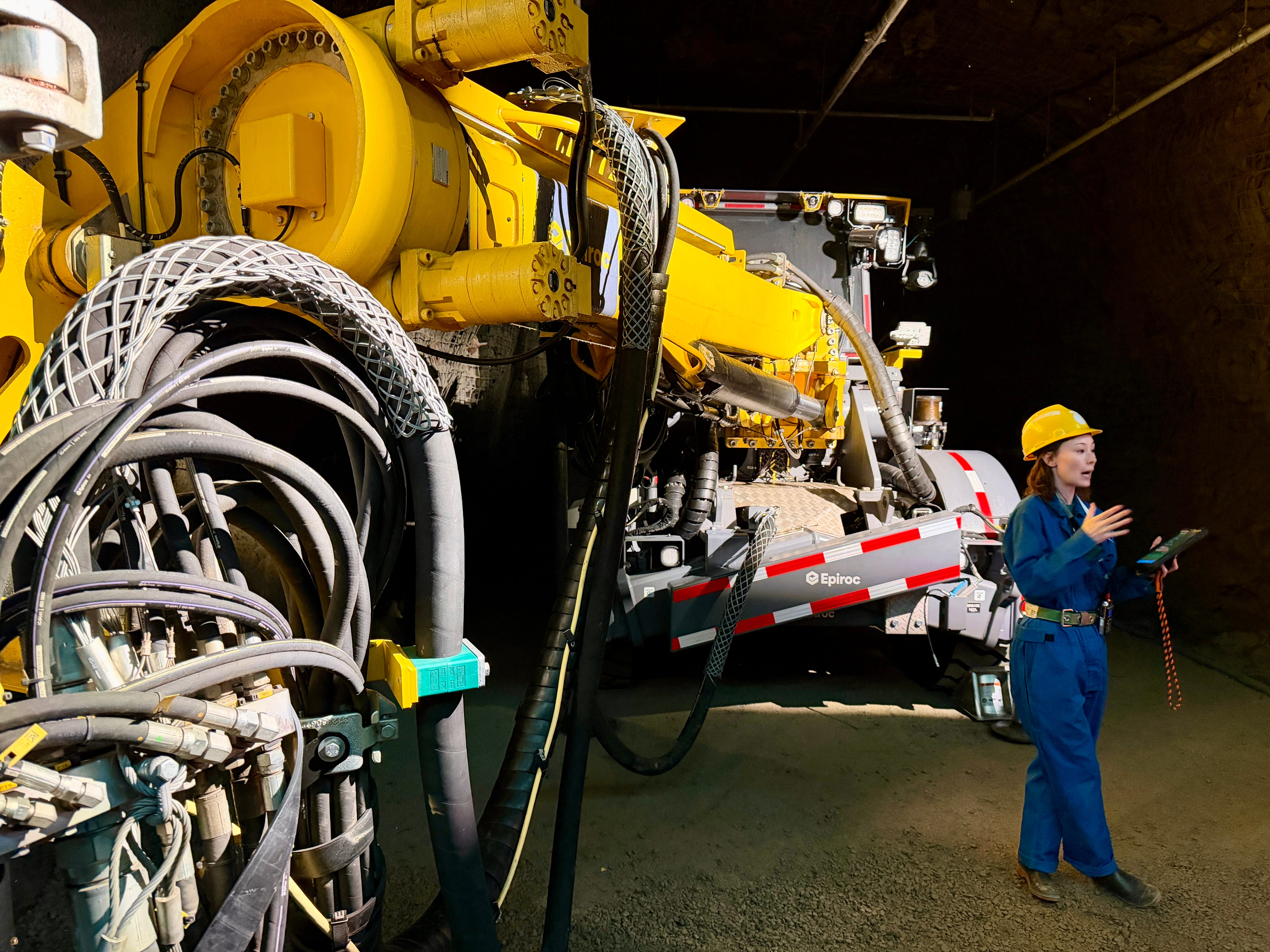
Like Caterpillar, the Swedish mining equipment company Epiroc is a major player in the electrification of underground mining equipment. This battery-electric Scooptram ST18 SG is one of its electric loader models, making it a direct competitor to the Caterpillar R1700 XE.
The Good and Bad News
In order to understand Canada’s emerging role in the global energy economy against the backdrop of its intensifying wildfire threat, it is helpful to zoom out a bit. Total global electric car sales passed twenty million last year, and global sales are forecast to reach twenty-three million cars in 2026. That’s close to one third of everything sold with a motor in it! But one third of all motors means there is still a surprisingly large number of non-electric motors to replace in the marketplace. Clearly, Sudbury’s mines have a role to play, and good times for that industry are on their way.
But the good news is even greater. Great climate writers like Bill McKibben, David Wallace-Wells, Emily Atkin, David Gelles, Akshat Rathi, Robinson Meyer, and so many others have been heralding this transition for some time. The world added over 800 gigawatts of new renewable capacity in 2025, a 16% increase over 2024. Total global installed renewable capacity is now over 5,100 gigawatts. Solar accounts for almost all of that growth because it is finally cheap. Installation costs have decreased roughly 70% since 2013. The solar boom is driving renewable energy to bypass coal as the largest source of electricity on earth by the middle of this year, replacing fossil fuel generation faster in more places than any other energy transition in history.
There are no signs this transition will slow, even in the face of climate driven disasters such as intensifying wildfires, because not only are those fires proving the validity of scientific projections, but they are simultaneously pushing the public to grasp more deeply the inherent dangers of fossil fuels. In the face of those realities, the inevitable march toward a new energy economy free of fossil fuels will only intensify.
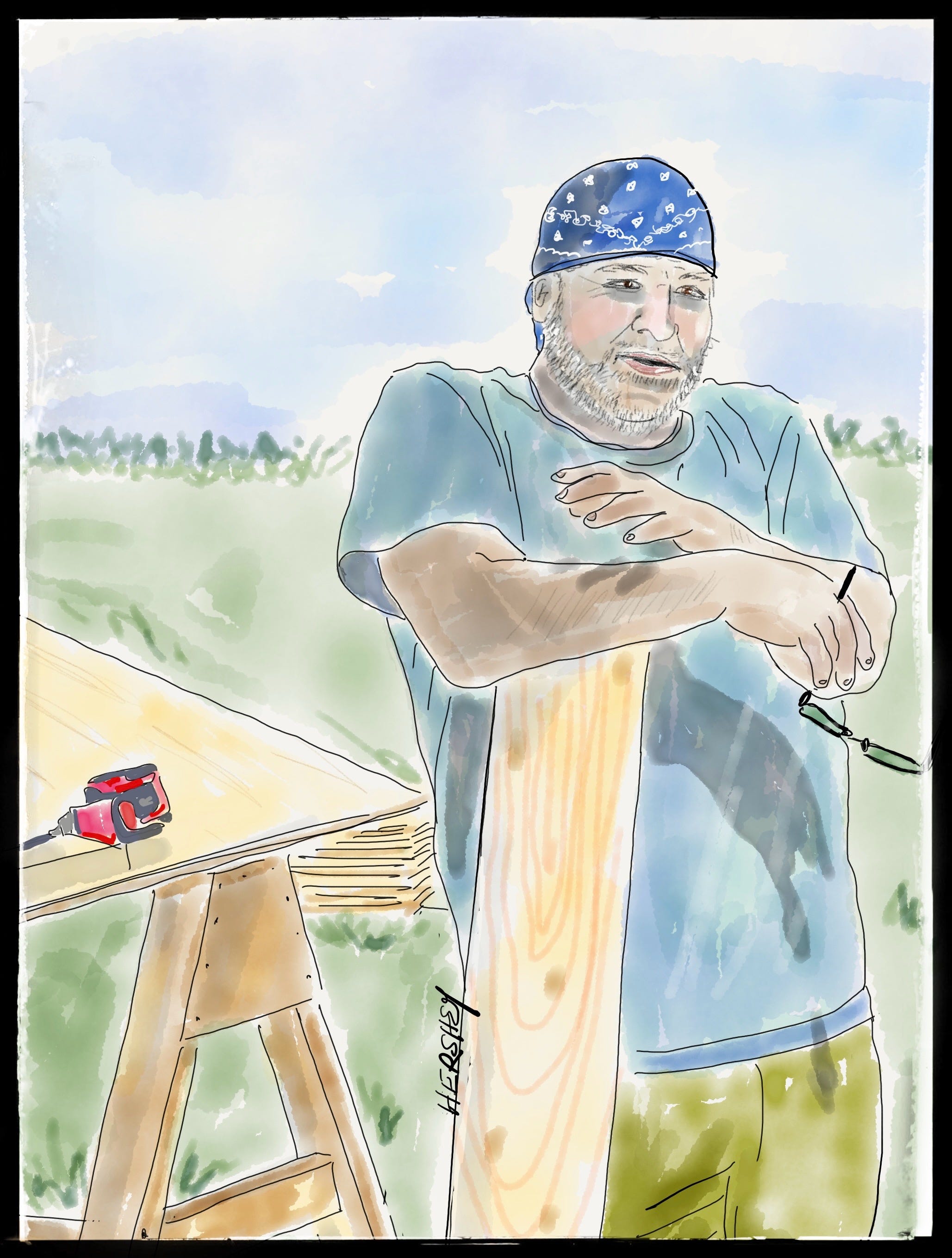
We met Grant as we were exploring small neighborhoods in Thessalon, Ontario. He was building a new shed next to a well cared for home on Lake Huron. Married to his high school sweetheart, Grant raised his two daughters in the only town he's ever lived in. He joked about his claim to fame - in 1969, he was the last baby born in the old Thessalon hospital before they tore it down. A firefighter and jack of all trades, Grant hasn't always had steady work. Some years back, in a more desperate time, he worked for the forest department keeping the trees trimmed and safe from fires. He had a manual curved saw on a long expandable pole. Working in the dead of winter, he earned $1.25 for every tree he stripped of branches all the way up to exactly 17 and a half feet, leaving no nubs longer than 4mm (about 0.16 inches), or shorter than 1mm (about 0.04 inches). Winters are much warmer now than when Grant was a child. He also thinks wind has drastically increased. Grant fondly described the "old days" when the entire town gathered around a big frozen part of the lake where they would have demolition derbies. He is well aware of how global warming is impacting his world.
But there is another half to this story. Even if every optimistic renewable energy and EV projection were to come true, and even if the United States, Russia, and a few other recalcitrant petrostates finally get on the same page as the rest of the world and there is a genuine unified politically driven global response to the climate crisis, what will come at us over the next twenty to thirty years is already baked in. Stated another way: it's bad now, and for a while, no matter what we do, climate issues are going to become more extreme. Just how extreme depends on how quickly the world lowers emissions.
If the world were to stop creating emissions tomorrow, current models suggest global average temperature will continue to climb for several decades. Then we will hit a plateau. Sea level rise, ice loss, regional temperature extremes, and patterns of extreme drought and precipitation will continue to unfold over longer timescales. The good news about decarbonization and the bad news about what’s already locked in are not contradictory realities. They’re the same story, told from two different perspectives.
When it comes to thinking about a “place” - in this case the North Shore of Lake Huron - any serious accounting of the coastline’s next twenty years has to hold both realities at once.
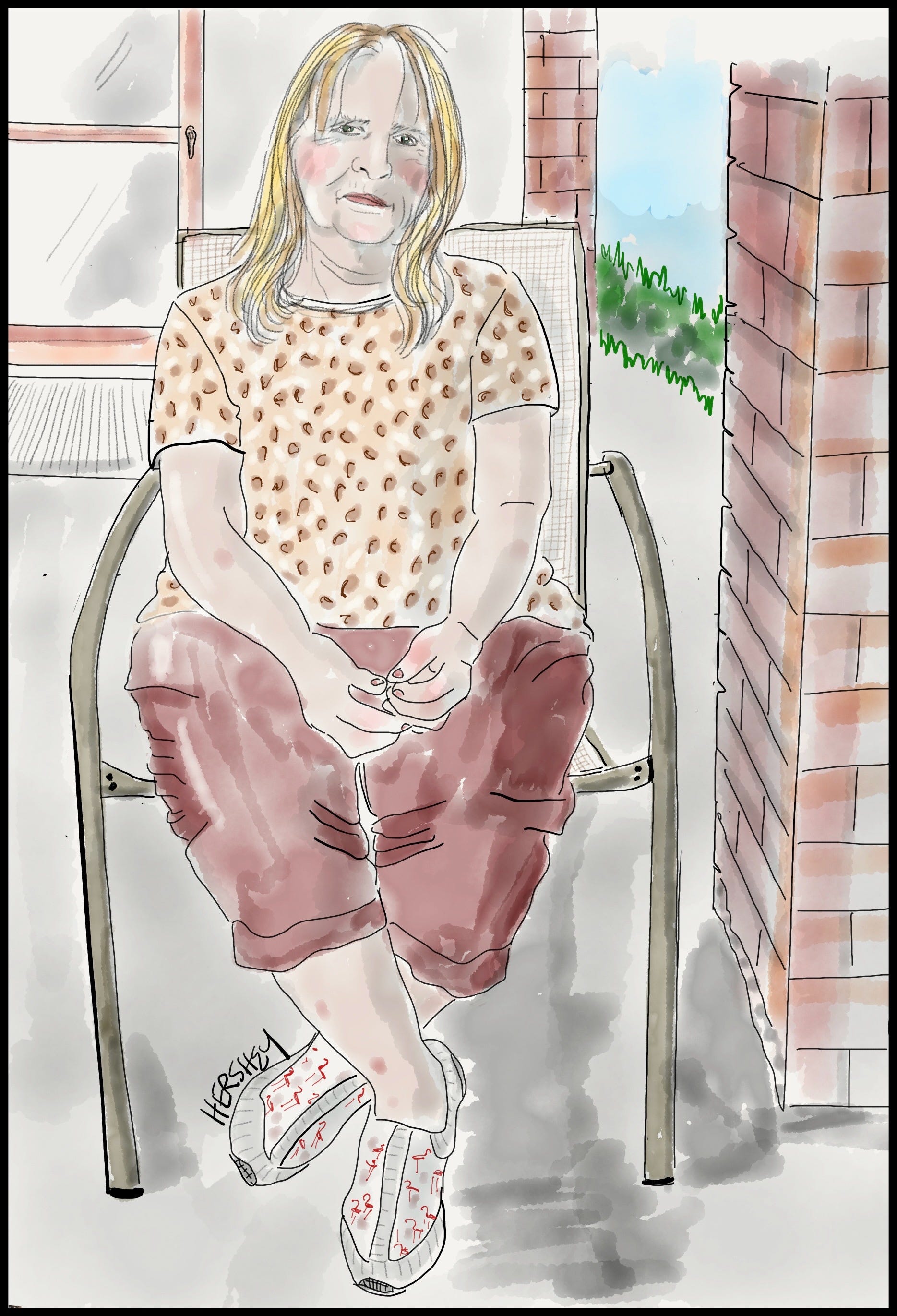
Jenny met Barb first in Espanola, Ontario. She was pushing a cleaning cart down the long hallway of the Clear Lake Motel. She was proud to tell Jenny that she was 84 and her determination to keep working, despite having had multiple back surgeries, was what kept her vital. She runs a tight ship with her husband, Bill, maintaining a mid-century motel where they raised their children in an apartment they made by converting several rooms into a usable space. Their son built a house across the street, and he keeps a keen eye on his parents. Their daughter lives in Kentucky, and is busy raising her own family. Bill and Barb met when they were 16, while Barb was working as a cashier at a grocery store. Almost 70 years later, their partnership is still going strong. Bill is the one who fixes everything and keeps the place operating smoothly, but he made it clear, "She's the boss!"
The Near Future
The wall of thick smoke we rode into outside Mindemoya was a preview to what we will encounter on future cycling journeys. If you look back in our posts, you will see that Jenny and I have been forced to contend with wildfire smoke on previous trips over the past few years. When I started writing carbonstories over eleven years ago, I would go looking for climate stories; now they find us. And more and more of the time, we are protagonists in the story.
As the earth warms, fire seasons across the world get longer at both ends. In many regions snow melts earlier in spring, and trees stay dry later into the fall. The boreal forest across the north shore of Lake Huron will burn more often than it used to over the next few decades. Lightning is the main driver of fire in remote country, and it increases with heat. The Great Lakes basin is projected to warm roughly fifty percent faster than the global average, with roughly 2 to 3.5 degrees Fahrenheit of warming locked in. Because the water is warming faster than the air above it, Lake Huron’s summer water surface temperature already increased more than 5 degrees Fahrenheit between 1968 and 2002. Warming trends bring warmer winters, more extreme heat, a longer growing season, heavier precipitation, and less ice cover, with the greatest temperature increases projected for the fall and winter seasons.
Lake levels are also part of the story. After a period of low lake levels for about 20 years, the Great Lakes rose at an unprecedented rate between 2014 and 2020, breaking several high water level records and causing widespread flooding and severe shoreline erosion throughout the Great Lakes basin. Then they fell back to near-average levels by the end of 2024. Researchers expect water levels to fluctuate even more over the coming years.
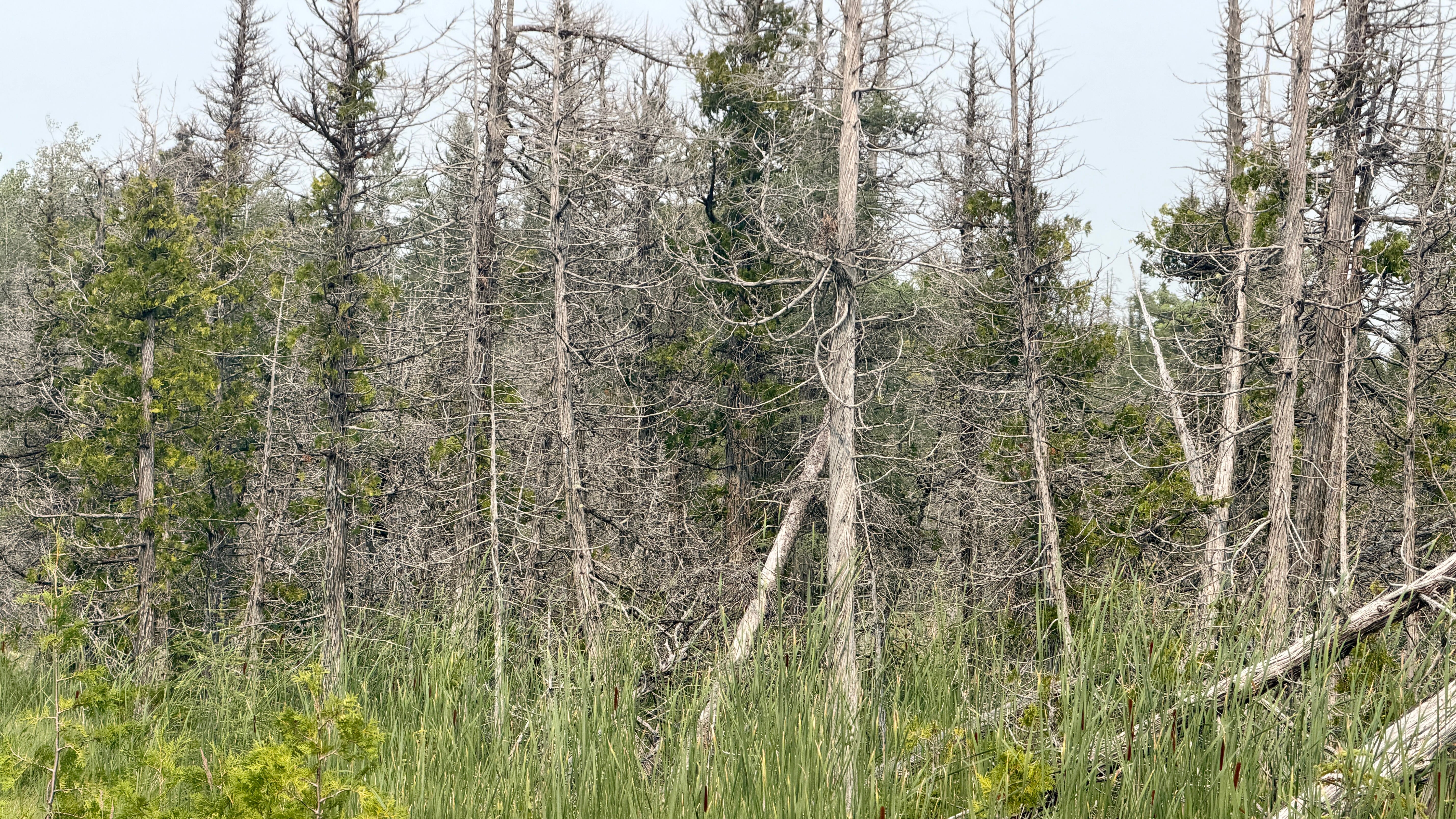
Dead cedar along stretches of marsh on the shore are casualties of the record high lake levels in 2019 and 2020. Water stayed high long enough to drown out root systems. The lake is rising again this year after a few lower years. The pattern will be wider swings in both directions.
The land along our entire cycling route is in a transition zone. As the climate continues to warm, the boreal forest is retreating north, and sugar maple and other more temperate species are taking their place. The same warmth is also pulling deer ticks further north. I am reminded of a story Jenny told me a few weeks ago. Stopping for coffee, Jenny met some transplanted New Yorkers who expressed their joy that Lyme disease was rare on the Bruce Peninsula. Her response was, “well, maybe for the next five minutes.”
A cyclist riding here twenty years from now will notice more maple and birch and fewer spruce and jack pine. Birds will be a bit louder, supporting noisier warblers and thrushes that prefer hardwood forests. Moose, already retreating from the southern edge of this range because of warming, will be even rarer. The north shore will still have clear days, and the water will still be flat and blue enough to photograph. Visitors will still be able to enjoy the same overlooks. But the good days will be offset by the frequency and character of the bad ones. Smoke will arrive less as an event and more as a natural part of the season, perhaps as a haze showing up on the horizon by midafternoon on most days in August, thickening toward evening and clearing again by the following noon, only to return the next day. By then the smells will have changed, even on the good days. In a bad summer such as this one, an unusual number of distant wildfires can produce a temporary sense of apocalypse. But in 2046, wildfire outbreaks in Ontario will be roughly double what they are now, and the distinction will be apparent most days, and made even sharper by whatever is burning closer. A rider on this shore may not be able to remember what August smelled like without smoke, similar to how a person who has lived beside a busy highway stops hearing the traffic.
Colder water in Lake Huron used to generate a greater amount of humidity, especially in the summer, that acted simultaneously as a moisturizer and cooling system. That system is weakening. Because ice cover is thinner and lake water now warms faster than the air above it, the shoreline responds less to localized circumstances, and more directly to whatever the sky is doing. This creates a strange paradox: in twenty years the good days will be very good, with calm water and unusually clean air. But the bad days will be far worse, because the surface humidity of the lake will have far less impact.
What is easy to miss is that none of this will arrive as a fixed reality. Every bad week still passes. The sky clears, the AQI drops, the ferry runs on schedule again, and we all feel relief. It was bad, but it’s over now. Except it isn’t.
There is a version of elegy that grieves a thing already gone. There’s another version that grieves a thing still arriving. This is the second kind. The dolostone will still be sepia and even white, and the North Channel will still smell moist on a clear day. Rocks and lakes won’t disappear. But the Gore Bay kind of clear air, when reeds so green stop you on your bike, will be interrupted more often by the pewter orange kind of air we rode through for days. The alvar lake iris, orchids and grass of Parnassus that depend on a narrow window of moisture will thin out as that window shifts. Sudbury’s mines will keep running on the same boom and bust logic they always have, except the boom this time will be built on the metal that’s supposed to fix the very problem that is making the sky behave the way it did on our ride.
None of this is a reason to stop going, or to stop writing about it, or to stop believing the extraordinary global buildout described above is worth cheering. It’s a reason to hold both things at once. Buddhists understand the truer physics of it: everything changes, nothing is ever going to stay as it is. Yet, knowing that doesn’t stop the grieving. So let this be a small accounting of what there is to grieve. The honest thing to do, riding through it, is to let yourself feel the loss while there’s still time for the feeling to mean something. That’s the whole of what a bicycle can offer a story like this one - not a solution, just a slow enough vantage point to grieve a place while it can still hear you.
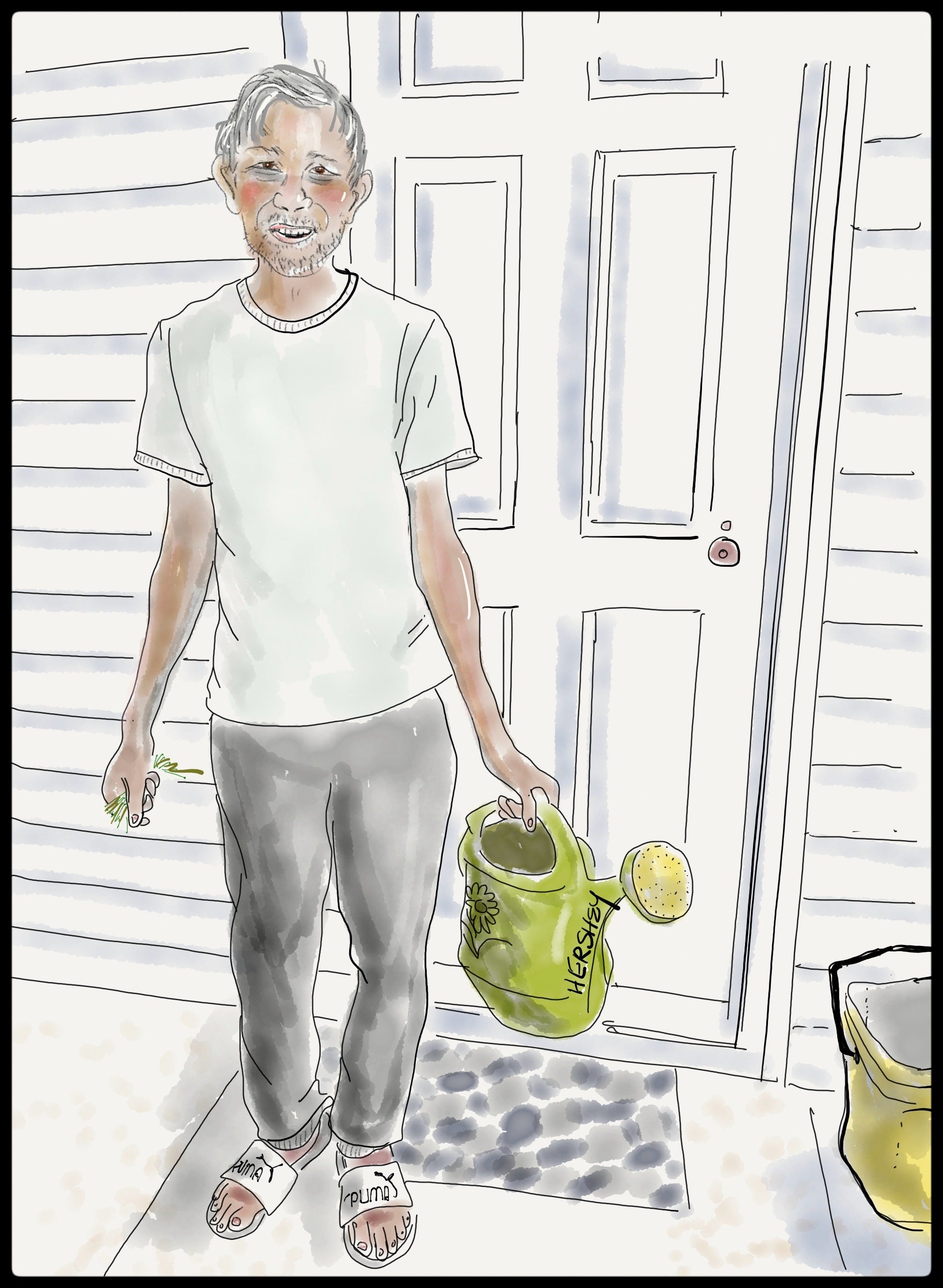
Nick has been running the modest but pristine Mindemoya Motel on Manitoulin Island for over 17 years. He and his wife came to Canada from India decades ago and raised a family in Toronto. Once their children were grown and settled, Nick bought the motel for a new chapter, a chance to pursue a passion. At 68, he still works hard. He has a green thumb, and the gardens around the motel are delightful. Nick and his wife love their simple life on Manitoulin.
Stay vigilant.
Evidence that others are reading our posts draws more readers. If one of our posts moves you, please click the like button at the end.
On Substack, there is a share button at the bottom of every post; you can send it directly to someone by email or text, or post it to your own social feeds.
You can also restack a post, which lifts it back to the top of your own readers’ feeds and introduces it to people who haven’t seen it yet.
Comments, even very short ones, inspires others to engage.
In an economy engineered to scatter attention, these small gestures are signals that help other readers find their way to us. We thank you for your attention. It means a lot to us.
This newsletter was written by Michael Chase, with drawings by Jenny Hershey. Unless otherwise noted, all material is the copyrighted property of the authors, including all photographs and drawings. Jennifer Hershey’s drawings can be enjoyed on Instagram at deeofo.

Jenny and Michael on their way to Gore Bay.
Sources
The Place
https://www.britannica.com/place/Manitoulin-Islands
https://www.thecanadianencyclopedia.ca/en/article/manitoulin-island-treaty-1862
https://www.heritagetrust.on.ca/plaques/manitowaning-treaties
https://www.wiikwemkoong.ca/history/
https://www.vice.com/en/article/this-ontario-indigenous-community-has-never-surrendered-its-territory/
https://www.cbc.ca/news/canada/sudbury/domtar-espanola-paper-mill-northern-ontario-shut-down-1.6958072
https://www.cbc.ca/news/canada/sudbury/bmi-group-industry-paper-pulp-northern-ontario-1.7506799
https://www.fws.gov/story/all-about-invasive-sea-lamprey
https://www.glfc.org/sea-lamprey.php
https://uwaterloo.ca/earth-sciences-museum/educational-resources/mining/mining-history-sudbury-area
https://www.canadianminingjournal.com/featured-article/on-the-homefront/
https://www.thecanadianencyclopedia.ca/en/article/inco-limited
https://www.cbc.ca/news/canada/sudbury/apollo-asronauts-trained-sudbury-50-years-ago-1.6096556
https://www.csmonitor.com/Environment/2020/0924/The-Sudbury-model-How-one-of-the-world-s-major-polluters-went-green
https://en.wikipedia.org/wiki/1978_Inco_strike
https://www.sudbury.com/lifestyle/1978-79-steelworkers-strike-subject-of-mick-lowes-new-novel-604026
https://www.sudbury.com/local-news/born-decades-into-the-citys-regreening-efforts-youngsters-learn-how-things-were-11302957
https://www.northernontariobusiness.com/industry-news/mining/mining-tour-allows-sudbury-to-show-off-expertise-technology-8961625
https://www.sudbury.com/local-news/vale-is-supplier-of-choice-for-automobile-battery-grade-nickel-7102957
The Good and Bad News
https://www.iea.org/reports/global-ev-outlook-2026/executive-summary
https://www.iea.org/news/close-to-30-of-cars-sold-this-year-are-set-to-be-electric-as-countries-and-consumers-respond-to-energy-crisis
https://www.iea.org/reports/global-energy-review-2026/technology-solar-pv-and-wind
https://thundersaidenergy.com/downloads/solar-costs-a-breakdown-over-time/
https://www.iea.org/reports/renewables-2025/renewable-electricity
The Near Future
https://www.ouranos.ca/en/climate-phenomena/forest-fires-projected-changes
https://climateinstitute.ca/news/fact-sheet-wildfires/
https://www.nature.com/articles/s41612-024-00781-4
https://elpc.org/resources/the-impacts-of-climate-change-on-the-great-lakes/
https://glisa.umich.edu/resources-tools/climate-impacts/temperature/
https://www.sciencedirect.com/science/article/abs/pii/S0380133009001294
https://glisa.umich.edu/climate-change-in-the-great-lakes-region-references/
https://glisa.umich.edu/lake-huron-retrospective/
Your essays are astonishing. The detail, the knowledge, the curiosity, the ability to see and hear and make sense of things are all on some other level. Jenny's illustrations are every bit the level of perfection that your writing is.
Thanks for the excellent context, insights, anecdotes, photos - and Jennifer’s drawings! xx